

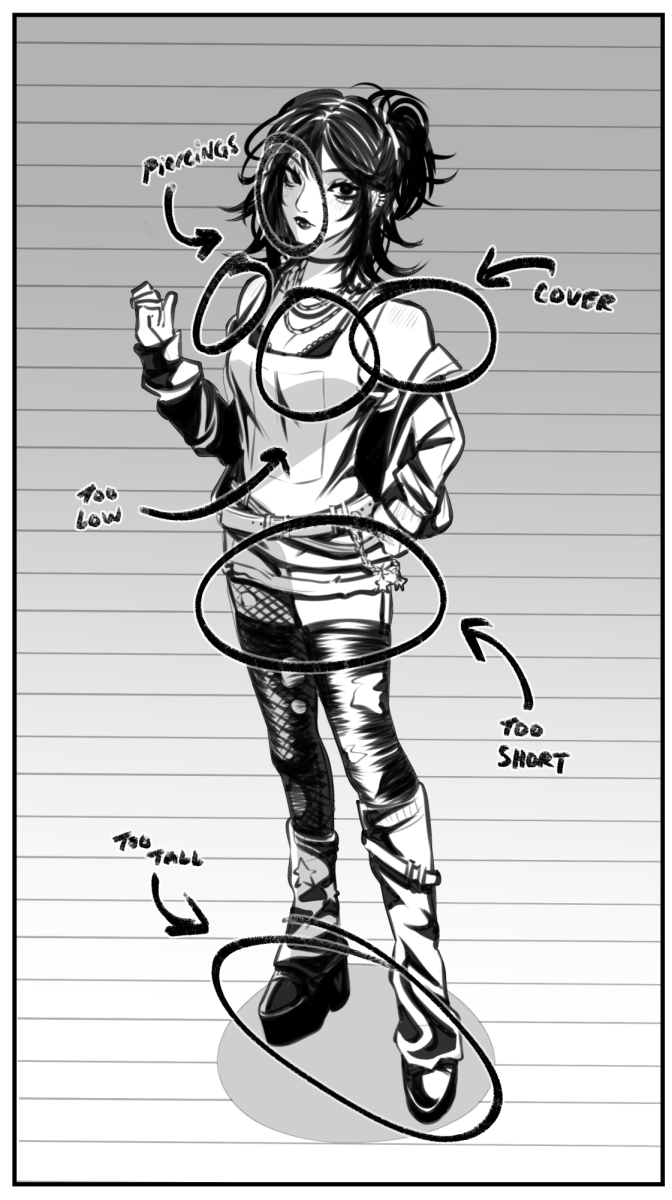
While attending SCHS, I have often butt heads with the dress code and those who seek to enforce it. As a girl with a visible bust, it was practically bound to happen. On one occasion, I was pulled from class and asked to change into an oversized T-shirt. Through that experience, I missed instruction time and was refused an explanation on account of the teacher being uncomfortable. Afterwards, I was left reeling – questioning how clearly the rules are written and how fairly they are applied.
Across the country, many other students have also protested against school dress codes. Policies that were founded to ensure professionalism and subvert distractions often rely on vague standards and language. This ambiguity disproportionately targets female students and disrupts students’ learning.
While many dress codes may sound straightforward, they often leave ample room for interpretation. SCHS’s rules say clothing must be “appropriate for school attendance” and not “disruptive or offensive to the educational environment.” California’s district policy similarly adds that attire should not “distract others or disrupt education.”
Yet as to what exactly counts as “distracting” or “inappropriate” is left to be decided. A 2022 “Education Week” analysis found that a whopping 93% of U.S. district dress codes use subjective terms like “revealing,” “modest” or “appropriate.” Such wording prompts subjective enforcement from staff, who are allowed to make decisions based on only their own discretion.
Furthermore, female students are often forced to bear the brunt of these policies. The Government Accountability Office reported in 2022 that more than 90% of districts ban clothing typically worn by girls – halter tops, strapless shirts, yoga pants – while only about 70% restrict items usually worn by boys.
The U.S. Justice Department has also noted that dress codes frequently “frame girls’ bodies as distractions,” and that enforcement disproportionately targets female, Black and LGBTQ+ students. With minorities more often deemed as inappropriate, the standard of appropriateness seems to be a reflection of the white heteronormative culture that prevails in society and dictates how people must conduct themselves.
Beyond who gets targeted, the way dress codes are enforced distracts students from what should be their primary focus: education. The GAO found that strict dress code enforcement often leads to chronic trends of missed class time and punishment, with Black and Hispanic students facing consequences at higher rates.
Strict dress codes dictated by authority are often justified as preparation for professional environments, but some critics argue that current rules reflect outdated values instead of modern standards of respect and safety. By having children model ideals of restrictiveness, schools go on to cement conservative ideals in the workplaces those children eventually enter. Rather than preparing students for stifling expectations of the future, schools create them.
Research groups and student organizations have advocated that schools remove vague terms like “distracting” and “inappropriate.” Instead, they lobby for dress codes that are gender-neutral and specific. In Washington, D.C., student-led research has allowed for needed change to commence. Students, staff and administrators were able to come together to create clearer, more equitable rules.
Some individuals, however, argue against changes, citing a need to respect traditional dress and set standards of propriety. According to the National School Boards Association, some critics worry that loosening dress codes risks students dressing inappropriately and undermining the values of respect schools aim to instill.
What individuals advocating for the status quo fail to account for is the continual shift in standards. From the 15th century to the 17th to modern day, what society has deemed appropriate has undergone mass revision. Fashion historian Valerie Steele noted that even within the last century, norms have swung wildly from fully-covered women in Victorian times to the acceptance of casual wear in modern workplaces.
Furthermore, the difference between societies, even now, highlights the subjectivity of the matter. For example, clothing considered modest and professional in Japan may be viewed as overly formal or restrictive in Brazil. By highlighting “tradition” as a reason for rejecting change, critics only highlight their arbitrary principles and lack of understanding of the word.
Ultimately, dress codes are meant to create order and stimulate respect in schools, but in many cases, they do the opposite. A better approach would be to establish clear, inclusive policies alongside training staff to enforce rules fairly without involving their personal beliefs.
If schools want a dress code that is to genuinely benefit everyone, then they should begin by ensuring that rules are equitable and considerate.
Alyssa-Fay Horton • Apr 14, 2026 at 6:28 am
I totally agree with you on that. Dress codes do particularly target girls and what they wear.💔