

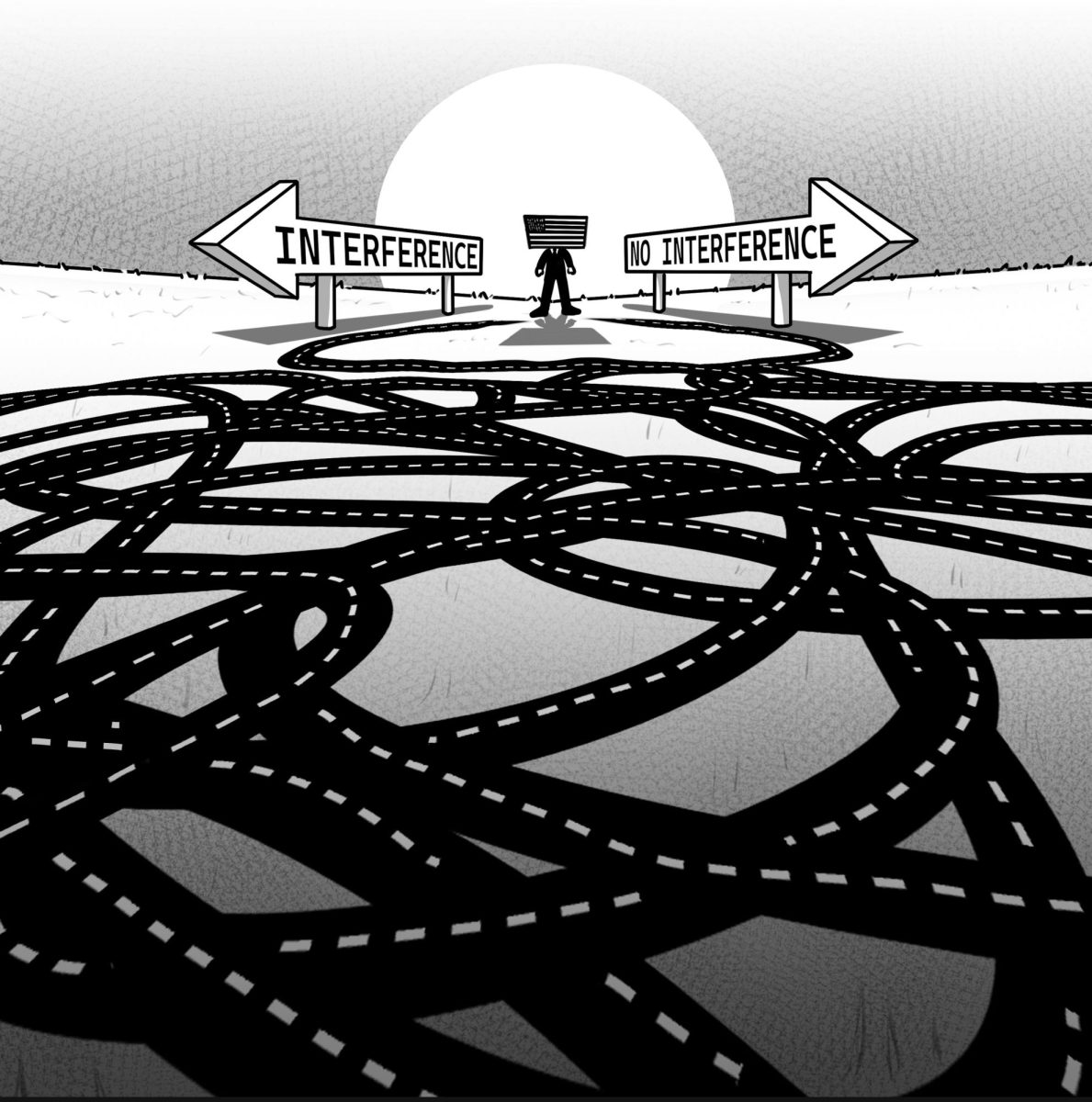
In the United States’ brief existence, it has managed to heavily engrain itself in world affairs, from the World Wars in the 1910s and 1940s to its occupation in Afghanistan from 2001 to 2021. In some cases, America’s interference has been welcome, like during WW2. Meddling, however, has led to harming innocent civilians. Thus, the U.S. should not interfere in foreign affairs unless it will improve the livelihood of the nation’s citizens.
When people of any nation are subjected to suffering, it is the responsibility of other countries to step in and help them. According to Brittannica, the Marshall plan aided European countries that had been devastated during WW2 by providing states with economic assistance to rebuild their states and produce to feed their people. These actions led to the improved livelihoods of the peoples by providing them with subsistence, shelter and a stable growing economy. The United States’ assistance ensured that the people were being fed, and it provided them with time to repair their fields so they could sustain themselves again.
Interference, however, is not always the best course of action. The implications of U.S. involvement is far reaching. One small act can lead to a domino effect, plunging a state into ruin. Such is the case in the U.S. aid in assassinating Patrice Lumumba – the former president of the Democratic Republic of the Congo – due to his allegiance with communist nations.
According to the Review of African Political Economy, Lumumba was an advocate for the Congo’s sovereignty, and following his death, the Congo was plunged into chaos. America’s rash decision of deposing a foreign leader was a catastrophic error that allowed a dictator to rule Congo, ultimately leading to the suffering of millions. Had the U.S. never involved itself in the state’s affairs, Lumumba may have been able to stabilize the state and improve the lives of millions, rather than causing millions to suffer.
Implementing an instrument of destruction without knowing its effects can be catastrophic. Such is the case of the U.S. using Agent Orange in the Vietnam War from 1962 to 1971.
According to Brown University, Agent Orange’s toxin causes brain damage akin to Alzheimer’s – a disease that leads to cognitive decline – and is correlated with higher risks of cancers. The toxin continues to harm Vietnamese citizens today.
What started as an herbicide turned out to have disastrous consequences, namely that of severe birth defects and neurological disorders. By meddling in Vietnam, the U.S. not only harmed Vietnamese citizens during the war but decades after by using a chemical they did not fully understand. Had the U.S. not involved itself in the war, thousands would have been born perfectly healthy, and thousands more would not have had to suffer the effects of Agent Orange.
Political interference can also lead to the exploitation of foreign nations, which is reflected in how following the kidnapping of Venezuelan president Nicolás Maduro, AP news reported that the United States allegedly targeted Venezuelan oil production. The United States’ claim to Venezuelan oil after kidnapping a nation’s leader is suspicious and warrants answers, seeming to be acting for a more corrupt agenda than for the common good. This act is unethical as it stands to reason that one should not kidnap an individual specifically to gain resources that are not rightfully theirs. Kidnapping a nation’s leader can have dire consequences, including throwing a state into chaos without a head to run it, which would cause the infrastructure of the government to fall into ruin. In such a case, the people would be left worse off than how they started with a politically unstable society that is more susceptible to crime.
Furthermore, the U.S. government’s authority comes from the people. In 1776, the U.S. declared its independence from Britain on the principle that the people were not being represented in Parliament on that principle. The U.S., however, has denied this right to the people of Hawaii.
In the late 1890s, the U.S. annexed the Hawaiian islands for its sugar despite the fact that the natives outnumbered the Americans and did not give their consent. Not only did this go against the very principles of popular sovereignty which the U.S. stands on, but in taking their islands, they took resources from the people, thereby encroaching on their livelihoods. The U.S. only took produce from the Hawaiians, and did nothing to help them.
Since Hawaii, the U.S. has exploited many nations for natural resources, often under the guise of helping to improve native lives only to impoverish them or ruin many lives. Now, the current administration has its sights on acquiring Greenland. The U.S., however, should not be encroaching on other nations unless it benefits the citizens of those countries.
To achieve this, the U.S. should not be looking out only for its interests but the well being of all. The U.S. should provide financial and medical aid to countries hit by natural disasters. They should assist in rebuilding and stabilizing war torn states. They need to prioritize helping build a better world, not tear it apart.