

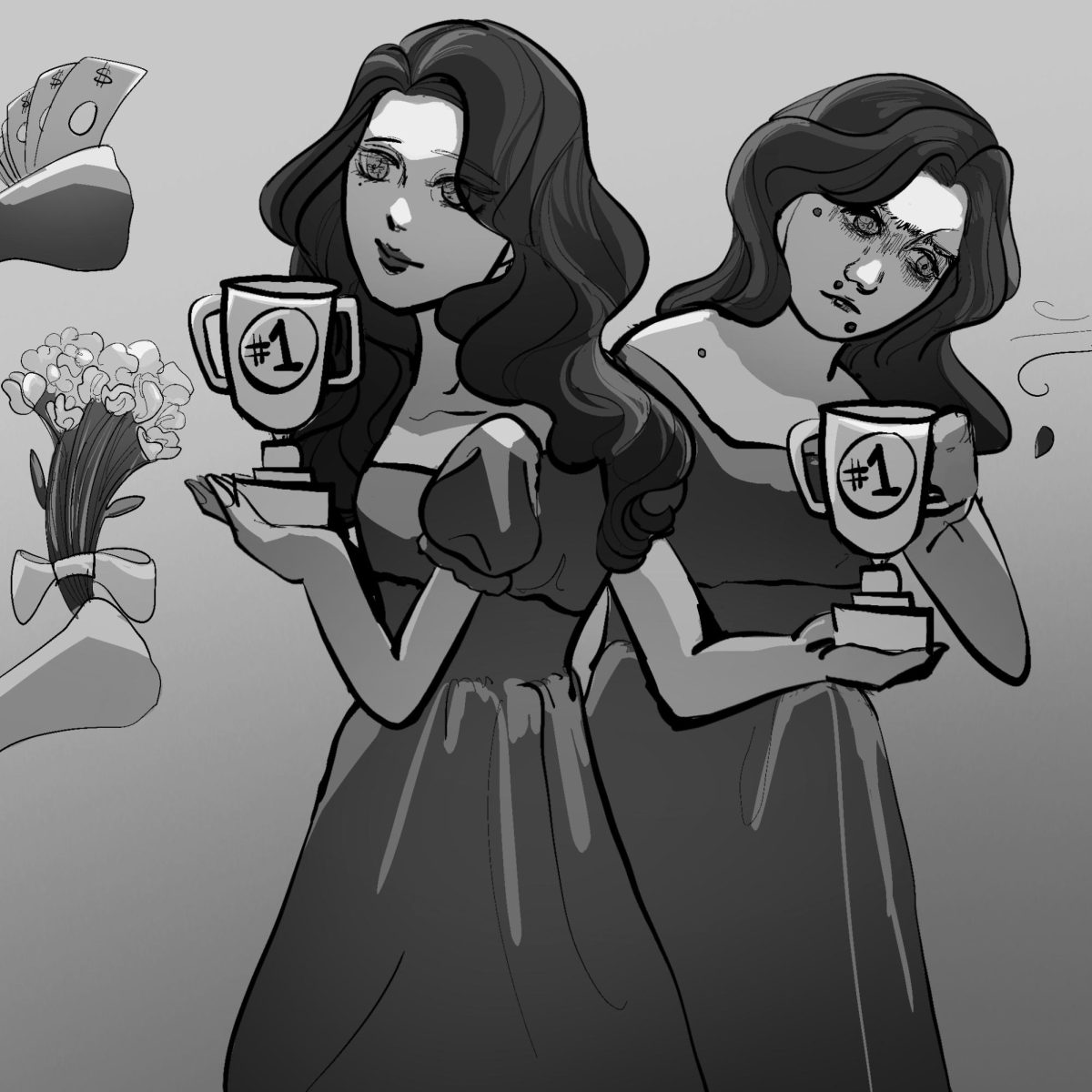
Being successful can often be distinctly tied to how one looks. Pretty privilege quietly shapes societal treatment and professional opportunities yet remains one of the most overlooked and normalized forms of advantage.
Conforming to societal beauty standards is a quality typically inherent and thus unearned, yet it frequently impacts daily interactions and first impressions. Psychologists call this the “halo effect,” where people often see a more attractive person as better. Specifically, a positive first impression based on someone’s looks will extend to the way a person perceives them in unrelated areas, including intelligence, wealth and trustworthiness. In short, a single good trait causes people to assume other positive traits exist.
While at first this may lead to small advantages, like certain students being called on more in class, they add up over time and lead to society being grossly biased toward particular people without just cause. Attractive adolescents are often given more positive social interactions and validation. While these may be minor interactions, they are often key in developing a child’s mind and often leads to them being more confident, more learned and in general, more reliant on their advantage. Meanwhile, others may be overlooked before merit is even considered.
The effects become even more pronounced in professional settings. A 2025 research study by INFORMS journal found that attractive people are 52.4% more likely to hold prestigious jobs 15 years post-graduation. Oftentimes, they are perceived as more confident and experienced even if their qualifications are exactly the same as other candidates.
Moreover, people often do not intentionally decide to favor a person by their looks, rather they subconsciously perceive the candidate in a more positive light. This results in attractive people being favored for interviews, networking events and customer-facing roles. In many cases, attractiveness registers as an unofficial credential and boosts a candidate’s value without ever appearing on a resume, resulting in a job market with more underlying bias than what is already acknowledged by discrimination laws.
Part of the reason pretty privilege is common is because it is deeply normalized and, in some ways, encouraged. Modern media and platforms are a constant in most people’s lives, and thus as are the stringent beauty standards pushed by them. People who fit the narrow beauty expectations are rewarded with attention and validation.
Oftentimes, the more attractive someone is perceived to be, the more attention they receive, which translates into greater influence and success. This process leads to a feedback loop as visibility leads to opportunities that reinforce those very same beauty standards.
At the same time, society often individualizes the problem, encouraging people to work hard to become more attractive, or to “glow up.” Instead of fixing or addressing the issue, people are blamed for not fitting into the mold. In doing so, this framing makes pretty privilege into an individual problem as opposed to a societal flaw.
Some argue that beauty is subjective or that hard work will ultimately matter more than appearance. There is truth in this as education, effort and skill are key factors to success. But acknowledging the effect of pretty privilege does not mean denying hard work. It means acknowledging that merit is not always evaluated on neutral grounds.
First impressions still shape opportunities and those are often influenced by attractiveness. Even if beauty standards vary culture to culture, consistent patterns still emerge on who is favored and why. Subjectivity does not simply erase bias, rather it makes it harder to distinguish.
Ultimately, fairness is impossible to achieve if unfair advantages go ignored. The first step to confronting pretty privilege is acknowledging it exists and people recognizing how perceptions of attractiveness influence their judgments. By doing so, people will be more able to objectively evaluate others opposed to subconsciously judging them.