

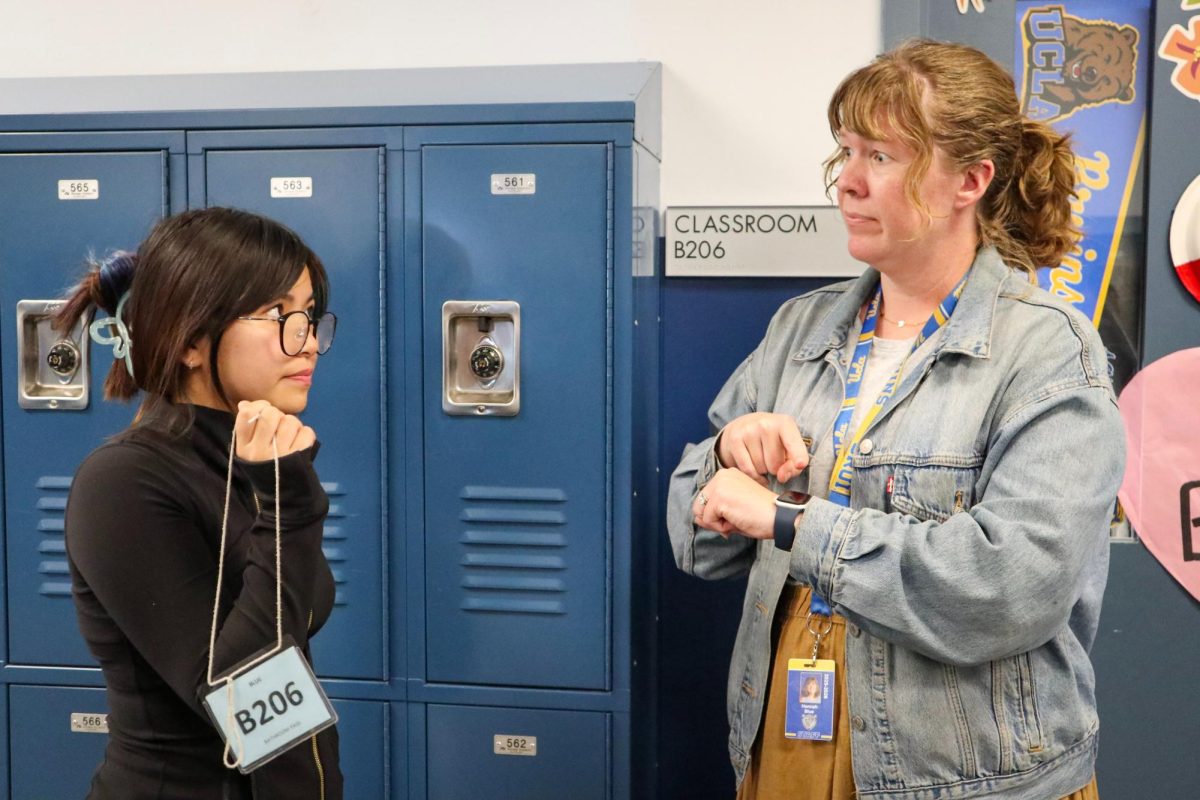
Throughout the school day, those seeking a break from class often opt for making rounds in the hallway while others find themselves socializing with friends. Though some consider class time breaks a necessary part of rejuvenating during a long class, others believe they can be detrimental to a student’s learning.
With end-of-the-year exams, some students may see school as a stressful environment. Students like sophomore Vanessa Dinh take breaks from time to time to prioritize their well-being.
“I have a lot of stress… which inspires me to have mental health breaks and urges me to walk out (of class),” Dinh said.
Despite the benefits of taking a short break to recharge, one of the main concerns is missing out on class material or work time. Due to this, freshman Anton Boost prefers to use class to work so he has more time for relaxing and other activities afterward.
“As long as I get my grades up and my parents are happy with me and I get into college, then I should get to do whatever I want outside of school,” Boost said. “If I get my work done in class, outside of school, that’s when I think that my social life matters more honestly.”
English teacher Hannah Blue agrees that students should be given the liberty to have a break. Some, however, may take advantage of this privilege and create more problems by not showing up to class.
“I am all in for a mental health break. I have had students who are agitated by something or tired, and I will offer the opportunity to go take a lap and come back. I think it can be helpful,” Blue said. “The problem is when a student says that they are going to wherever they have to go, then they are gone for a very long time.”
Hall administrator Connie Mamayorga acknowledged that some students leave class to cope with academic stress or due to the monotonous nature of some classes.
“Most of the time, they are out because classes are long. They (classes) are over an hour, and some of the kids get frustrated,” Mamayorga said. “It has a lot to do with the subject, or the teacher gets them bored, and they just want to walk around. The big issue is that we have those kids try to get other kids out of the classes, which is pretty much what they do.”
Although mental health plays a big role in leaving class, junior Jessilyn Klinger believes social environments are instrumental in how students behave and influence one another.
“It is a big part because I really think that you are who you hang out with, so if you are hanging around people that are bad influences and do bad things, then you have more of a chance to go down that path,” Klinger said. “I think it is kind of an unconscious thing where you are close with them and in a proximity, and it just makes you act out how they would naturally act.”
Though some students believe their reasons for skipping long periods of class are valid, most administrators maintain that the same rules apply to everyone. Blue explained how setting norms at the beginning of the year is essential.
“I try to be clear with my expectations. I do a lot of work at the start of the year to establish routine,” Blue said. “I also try to get engaged with my students, to get to know them, to chit chat with them so there’s that bit of connection.”
Hall administrator Frank Giacomelli believes that teachers and staff play a role in upholding the rules and limiting problems altogether.
“If we are going to have a rule, we need to be consistent with that rule, and that starts from the principal of the school and then all the way down through the teachers,” Giacomelli said. “We all need to be working together to enforce these rules and working with the students to understand why we need to enforce them. Consistency is something that has to happen.”