

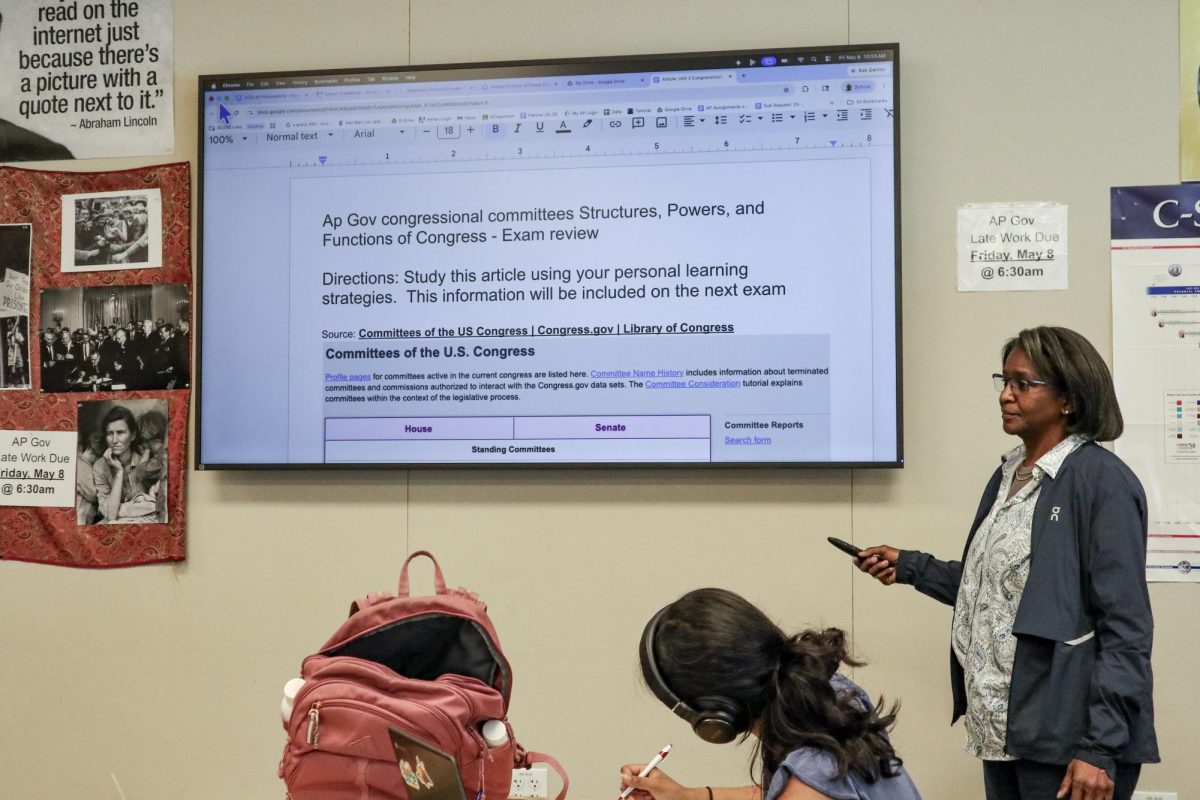
In March of 2026, SCUSD began installing new TVs to classrooms across campus as part of the district’s decision to revamp the school’s current technological applications like the projectors. The additions sparked discussion among teachers and students alike about how useful they will be.
As they were being incorporated into classrooms, freshman Morgan Lee found the TVs to be unnecessary because they were oriented opposite of where students were facing. As time went on, Lee discovered more issues.
“I thought they were kind of useless because all the TVs are kind of on the back of the walls in most of my classrooms,” Lee said. “The TVs (also) turn off all the time, and the teachers struggle setting it up, so it takes time away from the actual classes.”
Many students questioned how the school was able to get new TVs despite the recent budget cuts. IT technician John Cao shared part of the reason this was possible.
“We had a budget specifically for classroom upgrades for the school site,” Cao said. “We had some extra funds that we have used in the year for technology in classrooms. The funds couldn’t be used for payment, salary or facilities. It had to be technology.”
While a part of the incorporation process came from the budget, social science teacher Karen Henry revealed how the TVs were also from donations.
“It’s a combination of the two because here’s the physical TV. You have to have the budget, so they have one team come in and do the wiring, then another team comes in and does the installation,” Henry said. “They had to do that throughout the school, and they were doing three (TVs) a night.”
Despite the initial struggles getting used to the TVs, many have seen them as not only a simple solution to projectors but also a thoughtful long-term investment. Cao found that TVs are more reliable compared to the original projectors most teachers are accustomed to.
“To get a good projector, costs are getting close to $800 to $1,000, plus the bulbs keep burning out. There’s issues supporting it,” Cao said. “TVs have the pros because right now, they’re cheap. They’re $800 so that they’re the same price as a projector and the brightness is better.”
Henry shared how the TVs include additional features, such as better speakers and microphones, but does not foresee any major changes with her own teaching style.
“TVs come with microphones, so you could use it to give a presentation. I don’t know why, but it has a smaller one that a person could wear around their neck when they’re talking.” Henry said. “I don’t feel that it changes my teaching process. It complicates my life. I have to reorient and figure out how to comfortably be behind students.”
Despite being integrated toward the end of the school year, sophomore Yixian Wang observed that the TVs allowed students to absorb material from the screen better than before.
“Now, we have a TV at the back of the classroom… I feel it’s very helpful because if you cannot see one of them, you can always look at the other one,” Wang said. “I think TVs are great things that they did to school… and it could benefit the students’ study environment.”