

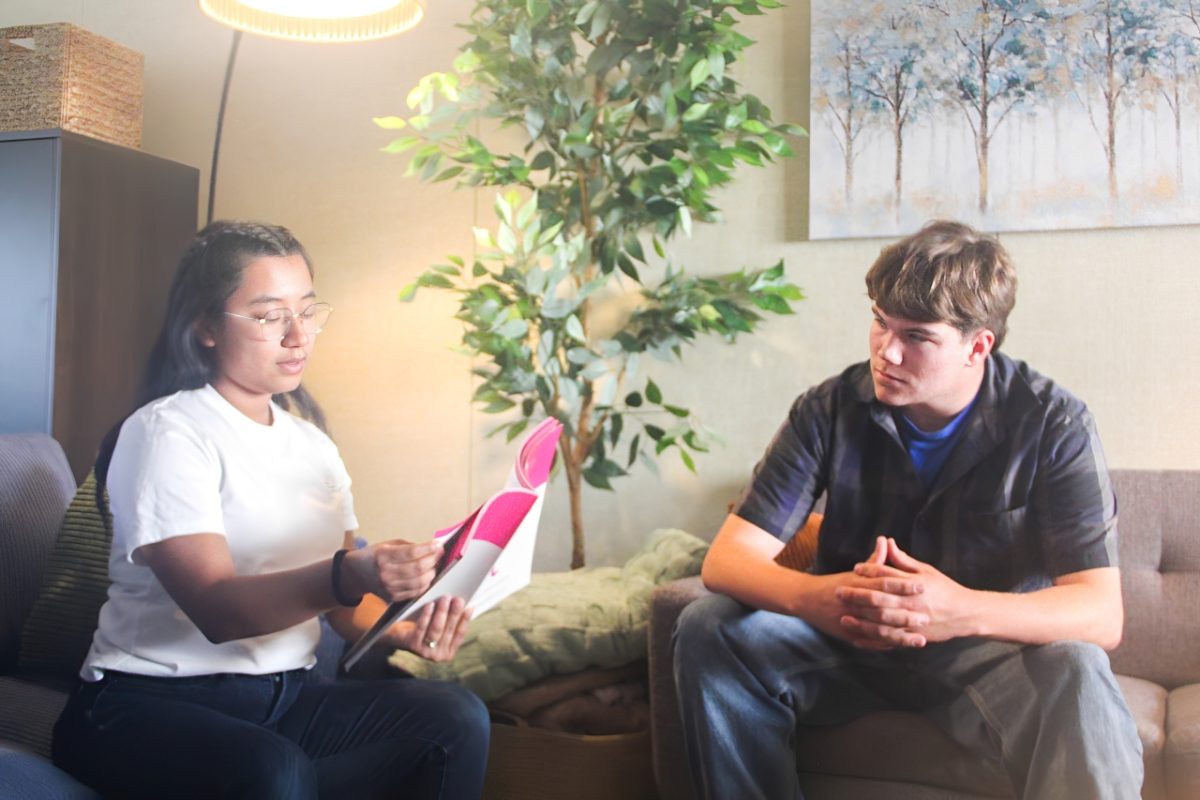
In the 2025-2026 school year, SCHS implemented the Teen Mental Health First Aid program. Founded by seniors Julie Arias and Luke Bettencourt, the goal was to get students more involved within leadership and mental health advocacy.
A handful of students selected by teachers were given the opportunity to participate in three 90-minute sessions during tutorial and lunch to learn about teen mental health. During these sessions, sophomore Yuna Wong was able to learn about the hidden mental health struggles many face.
“A lot of times, people aren’t informed or are unsure about what mental health or challenges could mean in certain ways,” Wong said. “There are different ones, so you can’t assume that if they’re not showing certain symptoms, then they’re not going through mental challenges.”
One of the members, junior Noah Ewing, believes the program emphasized the importance of prioritizing students and their opinions to create a healthier environment on campus.
“The point is to reach all forms of the student body, so we have people representing the underrepresented students, the English language learning students,” Ewing said. “We have different types of people in this group. We’re members of the student body who you can rely on to come and speak to us about these things and about any type of mental health crisis.”
After completing the program, Ewing discovered how he can help students who struggle with mental health components like substance abuse.
“Me being upperclassman, I’ve seen it a lot, and there are reasons behind it,” Ewing said. “The use of drugs, drinking of alcohol, it’s a way of coping, and I learned about why people cope and how I could help people cope in a safer and more positive way instead of isolation or using drugs.”
Beyond unhealthy coping mechanisms, insensitive uses of professional terms have also become increasingly common. Arias highlighted how the program could prevent these actions and promote understanding.
“Oftentimes, especially in school, we hear words that might unknowingly be hurtful like, ‘Oh, I’m so schizo right now,’ ‘Oh, I’m being bipolar,’” Arias said. “We unknowingly say things that could be harmful and could be stigmatizing to some people, so programs like these really help with awareness.”
One of the hurdles students and staff faced when initiating the program was scheduling sessions. Community Health Outreach Worker Jhoanna Arias-Hernandez recalled the struggle of pinpointing a period for students to dedicate their time toward the sessions.
“We are very fortunate that these students were able to lend us their tutorial and lunchtimes. Ideally, I would like it to not happen during that time frame because tutorials are very important, and students have tests and quizzes to catch up on,” Arias-Hernandez said.
Having seen success with the program within SCHS, Arias-Hernandez shared that other high schools in the district are attempting to follow suit with the training.
“I reported our event to Wilcox and MacDonald, and they’re currently trying to get that rolling as well. The hope with us being the launching school is that we have this training every year for all interested students,” Arias-Hernandez said.
While the Wellness Center remains a safe place for individuals to vent or discuss issues with trained professionals, the program has enabled students to be a point of support for their peers as well. By training them on how to handle complex situations and offer advice, Arias believes that the sense of community at school is strengthened.
“You have that knowledge on mental health, have those tools, so you can be prepared for all kinds of situations where you don’t feel stressed about how to start, and you go into it with an open mindset to be available (to help) all your peers,” Arias said.
As the first student-led wellness program in the district, Teen Mental Health First Aid marks the beginning of a larger effort to prioritize the wellness of students both on and off campus. With plans to expand and involve more students, many believe SCHS is taking an important leap toward making mental health support available for everyone.
“It is a place where you can, honestly, as cliché as it might sound, be yourself. If you’re genuinely curious about things, there is no harm in asking questions,” Arias said. “It’s a place where you can explore mental health, explore mental awareness and overall, learn how you can help yourself and others.”