

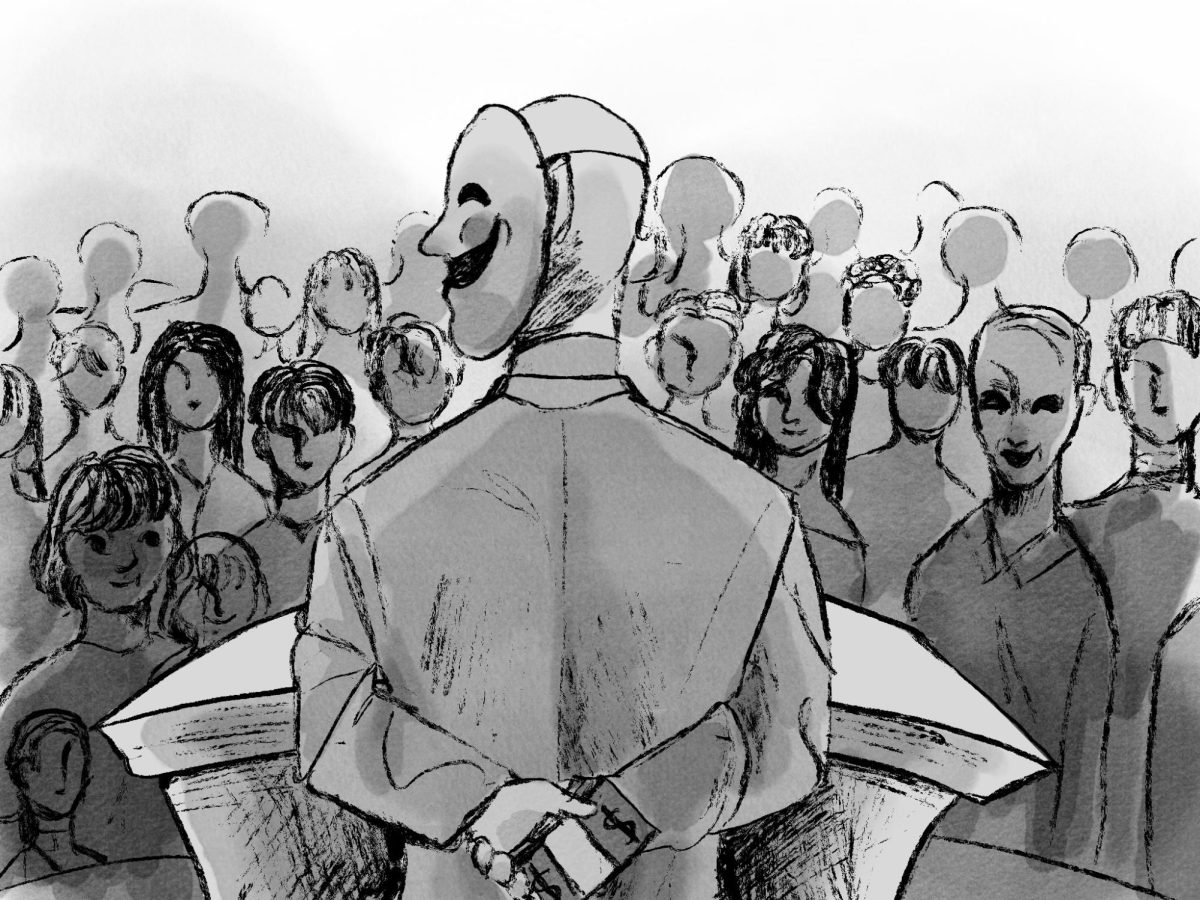
As of Zohran Mamdani’s inauguration as New York’s democratic mayor candidate in June, many have begun to experience shifts in political perspectives. Mamdani, a democratic socialist, gained national popularity throughout social media. While most supporters viewed him as the better option due to his promises in making public transit free and increasing wages, multiple factors may be the reason for their endorsement.
American politics tend to be extremely polarizing with a definitive line between Democrats and Republicans. This divisive party system has had a long-standing presence, but it has led many to fail to understand how subjective politics really is. Political support can be affected by various aspects like siding with the popular stance, choosing politicians or specific issues over policies, or choosing a party due to opposition of another.
With Gen-Z entering the political scene, an increasing amount of people have begun using social media as a platform to engage in political conversations. While this development has helped in educating many, it has also contributed to a sense of peer pressure to support one side or another by coercing people to be on the “winning side.”
The longstanding temptation to side with the widely-known option existed before social media due to propaganda and campaigns that gave off a sense of inferiority and FOMO to anyone who did not support them. Political FOMO along with selective consumption of news are one of the many factors that have led to a lack of understanding of the party system.
Pressure to conform with the popular viewpoint has caused many to censor themselves. A 2022 study by Siena College found that 55% of Americans avoid bringing up politics in their conversations in fear of social isolation or unwillingness to argue with people. Fear of being antagonized for expressing opinions only furthers the idea of having a socially-accepted view.
Additionally, numerous people tend to use biased sources. One survey found that U.S. voters were 10 to 30 percent less likely to know about news concerning the opposite party because they mostly consumed information that aligned with their pre-existing beliefs. Without proper understanding of what they do or even do not support, political opinion then goes from being subjective to being an automaton simply blindly following the prevalent side.
Furthermore, political viewpoints can be influenced by a politician and their response to specific issues. Oftentimes, a party is associated with the current politicians involved instead of the policies the party advocates for.
This relates back to the idea of people only acknowledging explicit representation of both sides. The Pew Research Center reported that 39% of Republicans and 40% of Democrats admit that the most significant reason for not identifying with the opposite party is the party leaders who represent it.
One must consider both the policies and the party leaders when making decisions about their political orientation. Without this understanding, people can make the wrong assumption that belonging to one party means they have to support every leader representing it.
Moreover, support for politicians is sometimes based on their response to certain issues. Mamdani was backed by both socialists and nonsocialists for his unique and promising visions for NYC’s economy. A Data for Progress study found that 72% of New Yorkers and 58% of New York Republicans supported Mamdani’s plan for free MTA bus service. Despite being from a different party, many of the Republicans were in agreement of his campaign and methods.
Even so, political support for a party can also be about opposition to another. This phenomenon is known as negative partisanship and entails some choosing to support a party because of a dislike for another one. According to a Pew Research Center study, 78% of Republicans and 68% of Democrats support their respective parties because of the harm they believe the other party may cause the U.S. With so many people emphasizing dislike for another party as the main reason for supporting theirs, the importance of the policies can diminish and the two party system is reinforced.
Some might argue that political subjectivity and polarization is bolstered by the unstable political climate. This, however, is not completely true. According to the Carnegie Endowment for International Peace, in a country where the norm is being extreme left or extreme right, there is little room for stability. Additionally, the standards of incomplete information and supporting the popular perspective only perpetuates the cycle of instability.
Political subjectivity is one of the weaknesses of the party system. From one perspective, maintaining an open mind is an effective way to reach mutual cooperation among a group. From another, reinforcing misinformation and shifting stances based on the popular one can lead to increased uncertainty. When considering what stances to take, it is important that one approaches with an open mind while still remaining true to personal values.